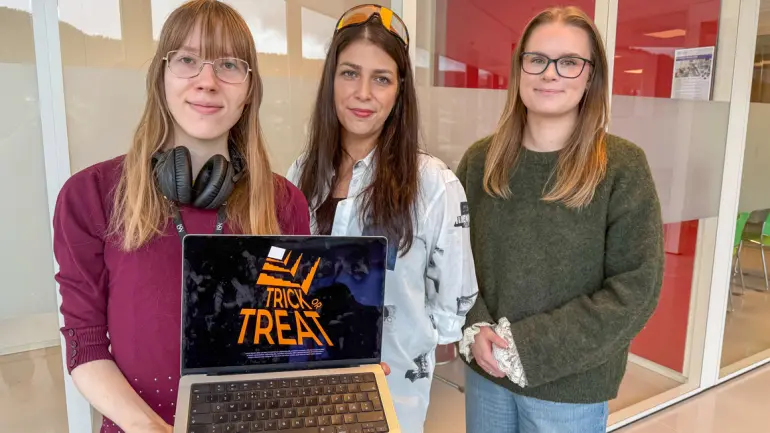
"In Poland, there have been several incidents in recent years on Halloween, where children have discovered harmful objects in their sweets. I experienced this myself when I checked my children’s sweets last year”, says Marta Olszanska.
She is studying graphic design at SWPS University in Poland. Her group created the Trick or treat campaign, which is aimed at an international audience.
“We’ve put a lot of effort into making it as clear as possible. In Norway, we don’t have the same context as in Poland, so we need to add more text underneath, for example”, says USN-student Vilde Helgerud. She is studying for a Bachelor in Design – Visual Communication and was part of Marta’s group.
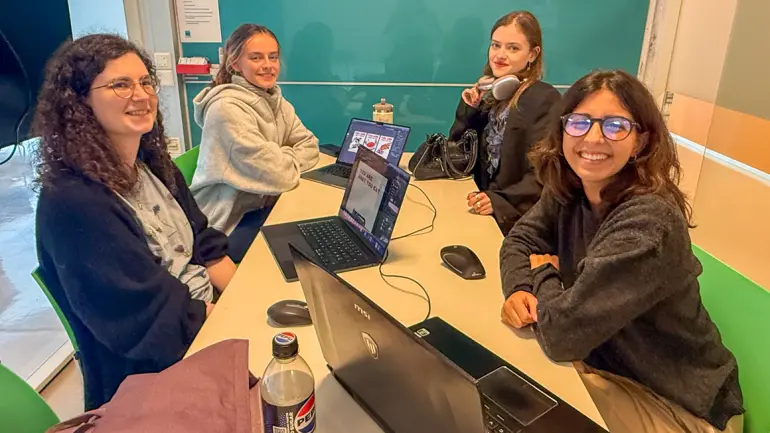
Another group, calling themselves No drama in Drammen said that the collaboration had gone very well, and without any drama at all:
“We’re creating a campaign about what we’re fed on social media, and have played around a bit with the saying You are what you eat”, says Maria Plaza, who is studying Industrial Design Engineering at the University of Zaragoza in Spain.
Reading between the lines
The workshop is part of an international Erasmus BIP project (Blended Intensive Programme).
The theme is “Between the lines”: how design can highlight what is not said directly, and why the ability to read between the lines is important for democratic participation.
The students worked on how to reach target groups, taking into account reading skills in Europe today and the latest PISA results.
What happens to democracy when an increasing number of people struggle to understand the information that affects their lives?
“34 % of Norwegian Year 10 pupils now perform below baseline level in reading, with the figure rising to 41 % among boys. For the first time, Norway is below the OECD average in all three subject areas. This is precisely the trend our project addresses. We just do it from a different angle, through design and communication rather than education policy” says Associate Professor Theo Sikkes from Bachelor in Design – Visual Communication at the University of South-Eastern Norway.
How society communicates with its citizens
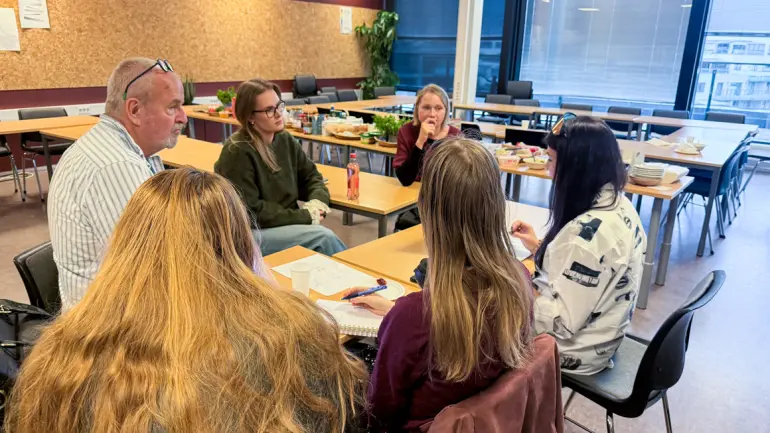
At the same time, the project is not just about school and reading, but also about how society communicates with its citizens.
International research shows that many people can read words and sentences, but struggle to understand complex texts, evaluate sources and see through hidden messages and disinformation.
Over the course of the week, the international student teams were tasked with developing campaigns, films, posters and digital concepts that highlight invisible barriers to communication, with strong support from five subject lecturers from the students’ universities.
The aim was to explore how design can help reduce information inequality, combat exclusion and strengthen democratic participation.
The programme also included contributions from international experts in communication, design, storytelling and legal design.
The Drammen campus thus became the venue for an international gathering of students, researchers and designers seeking to find new answers to one of the most pressing questions of our time: ‘How do we ensure that people can understand, participate and be heard in a society that places ever-greater demands on reading, source criticism and media literacy?’