Joint International Master in Semiconductor ChipS Integration and Innovation
USN, together with Aalto University in Finland and Budapest University of Technology and Economics, offers a joint master’s degree. As demand for highly skilled engineers continues to grow, there has never been a better time to specialize in this field.
-
Closing dates: Deadlines: Erasmus Mundus and applicants from outside EU/EAA: 10 January. Applicants from EU/EEA: and Nordic countries 15. April
Joint International Master in Semiconductor ChipS Integration and Innovation
You are applying for:
Vestfold
Full time
Smart to get ready before you continue:
- Application code: 7191
If you copy the code, it will be easier to find this programme in the next step. The code is copied
Apply for admission now
Study facts
-
Campus: Vestfold -
Study level: Master's degree -
Progression of study: Full time -
Start up: Autumn 2027 -
Teaching model: Off Campus and On Campus -
Credits: 120 -
Closing dates: Deadlines: Erasmus Mundus and applicants from outside EU/EAA: 10 January. Applicants from EU/EEA: and Nordic countries 15. April -
Application code: 7191 -
Semesters: 4 -
Teaching Language: English -
Number of students: 30
Why Semiconductor ChipS Integration and Innovation?
The future is being built on semiconductors.
From artificial intelligence and smart healthcare to autonomous vehicles, renewable energy, and next-generation communication systems, semiconductor technologies are driving the innovations that shape our world.
This programme offers a unique opportunity to study at three leading European universities in Finland, Norway, and Hungary, combining academic excellence, hands-on laboratory training, industry collaboration, and international mobility.
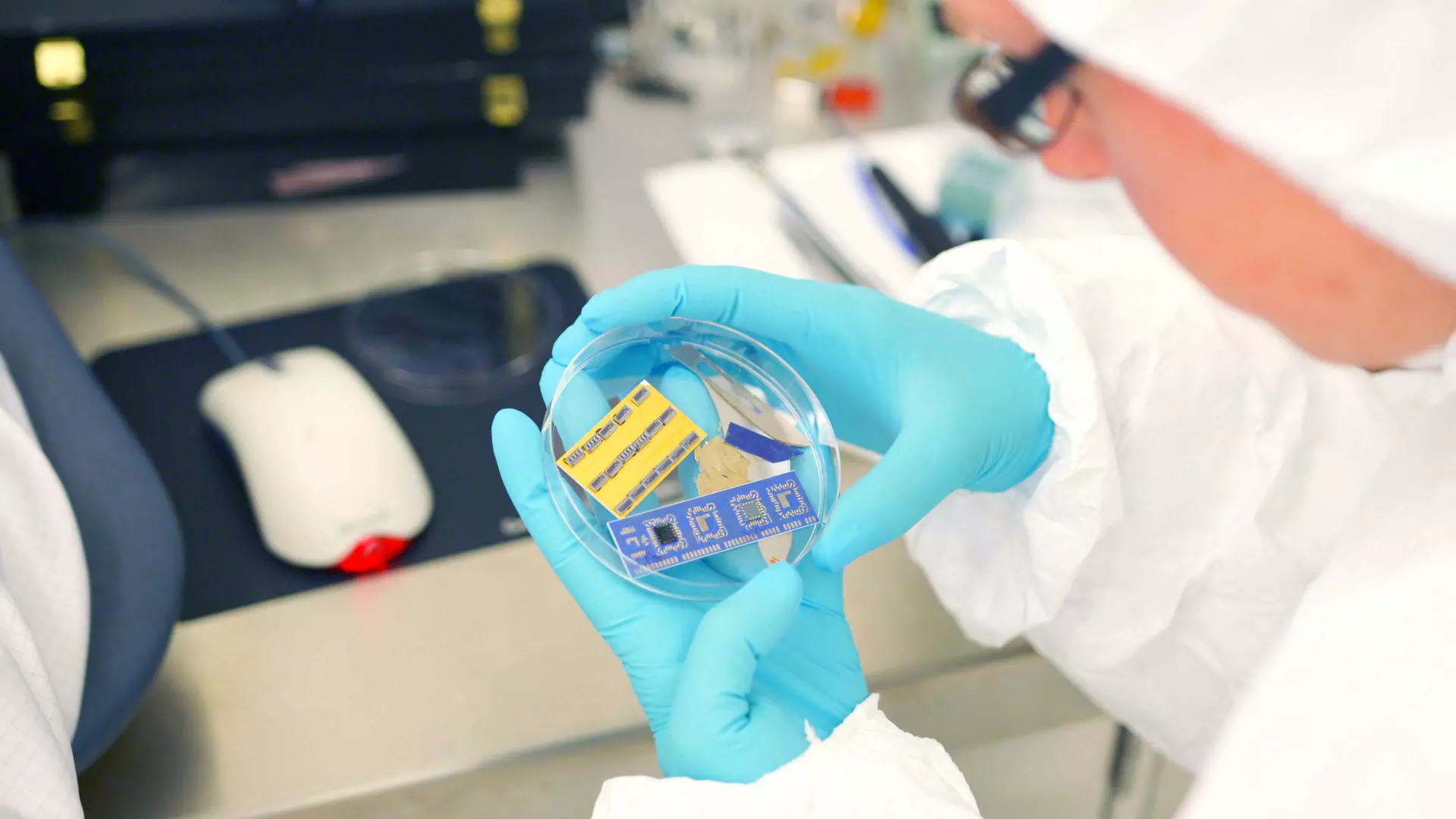
You will gain practical experience with semiconductor manufacturing, chip design, smart systems, digital twins, artificial intelligence, and emerging technologies while working in state-of-the-art laboratories and learning from internationally recognized researchers and industry experts.
This programme is a global experience that extends far beyond the classroom. You will join a diverse cohort of talented students from around the world, build an international professional network, and develop the technical, entrepreneurial, and intercultural skills sought after by employers worldwide.
Whether your ambition is to design the next generation of semiconductor devices, drive technological innovation in industry, launch a start-up, or pursue a research career, this programme will give you the knowledge, experience, and global perspective to make an impact.
Study across Europe. Work with cutting-edge technologies. Become part of the future of semiconductor innovation.
Disclosure
The Erasmus Mundus programme is subject to the signing of the Grant Agreement, expected in mid-November 2026. All applicants will be informed if the programme is unable to proceed.
Where can I work?
Graduates are prepared for careers in the rapidly growing fields of semiconductors, microelectronics, smart systems, artificial intelligence, and digital engineering. Opportunities exist across a wide range of industries, including electronics, telecommunications, healthcare technology, renewable energy, automotive systems, robotics, and industrial automation.
In companies that develop and manufacture smart systems, graduates can work in areas such as product development, manufacturing technology, production management, quality management, and project management. In organizations that deploy and use smart system technologies, career opportunities include research and development, business development, technical consulting, marketing and sales, and project management. This broad skill set enables graduates to contribute to the entire innovation cycle, from technology development and production to commercialization and strategic growth.
Working with the local business community
The programme includes the most current industrial clusters as associated partners at Norwegian and European level: European Platform on Smart Systems (EPoSS) and Norwegian Centre of Expertise, Micro- and Nanotechnologies (NCE-MNT). This enables visits to relevant industries, guest speakers from the business community, as well as opportunities to take the master project in an industrial company in Norway or elsewhere in Europe.
What you will learn
In this programme, you will develop advanced engineering skills that combine theory, hands-on laboratory experience, and real-world problem solving. You will learn how to design, fabricate, model, and integrate intelligent electronic systems while working with cutting-edge technologies used in industry and research.
As an Erasmus Mundus student, you will study in Finland, Norway, and Hungary, gaining both technical expertise and a truly international perspective. In Finland, you will build a strong foundation in semiconductor physics, artificial intelligence, sustainable and reliable electronics, innovation, and entrepreneurship. In Norway, you will gain extensive hands-on experience in microfabrication, cleanroom processing, sensors and their integration with semiconductor devices for smart systems, digital twins, and materials & device characterisation through advanced laboratory training. In Hungary, you will deepen your expertise in semiconductor device design, integrated circuits and mixed signal chip design, system-level engineering, power semiconductors, and advanced modelling tools widely used in the semiconductor industry.
The programme's mobility pathway allows you to experience different academic cultures, collaborate with students from around the world, and build an international professional network while developing the adaptability, teamwork, and intercultural skills highly valued by employers.
Through laboratory training, industry projects, summer internships, Winter and Summer Schools, and close interaction with leading researchers and industry experts, you will develop both the technical and professional competences needed to succeed in a global engineering career.
By graduation, you will be prepared to contribute to the next generation of sustainable, intelligent, and connected technologies through careers in industry, research, entrepreneurship, or further doctoral studies.
Learning outcome
The programme is designed to equip graduates with advanced scientific knowledge, practical engineering skills, and transferable competences relevant to the rapidly evolving semiconductor and smart systems sector. Through a combination of coursework, laboratory training, mobility, internships, and project work, students achieve the learning outcomes described below.
Knowledge
K1. has advanced knowledge within the field of semiconductor chips, spanning various and heterogeneous technology platforms. This includes their functionalities as sensors, actuators, transducers, analogue and mixed signal processing, and related digital microelectronics.
K2. has in-depth theoretical and practical knowledge in design, modelling, fabrication, and testing of semiconductor chips as well as integrated systems.
K3. has advanced knowledge in integrating diverse semiconductor chips into larger systems for applications in all sectors of society, including healthcare, transport, communication, security, environment surveillance.
K4. has thorough knowledge of current research and methods within the field and can apply new research results.
K5. has intermediate knowledge in innovation, entrepreneurship, and business creation.
K6. can analyse engineering problems based on the role of semiconductor chips and systems within the technological evolution and the impact on society and sustainable development.
Skills
S1. can apply his or her knowledge in an independent and systematic manner by breaking down complex problems into subtasks, selecting relevant methods and producing innovative solutions even for new areas.
S2. can analyse and deal critically with various sources of information and use them to structure and formulate scientific arguments.
S3. can independently assess and select relevant tools, methods, models, calculations, and solutions for problems in the field of semiconductor chips and integration.
S4. can apply his or her knowledge to contribute to establishment and development of businesses.
S5. can carry out an independent, limited research or development project under supervision and in line with norms of research ethics.
S6. can explain the European society and political systems exemplified by Finland, Norway and Hungary.
Competence
C1. can communicate knowledge within his or her field of study in writing and orally to different audience groups in a well-structured, clear, and objective manner.
C2. can reflect on ethical, societal and sustainability effects of one's own work.
C3. is conversant with the semiconductor supply chain, the socio-economic environment of semiconductor chips manufacturing and its impact on EU's long-term circular economy goals.
C4. can work in multidisciplinary and multinational groups with complex tasks: plan projects, delegate, and coordinate tasks, and help the group in achieving results.
C5. have an international perspective on his or her profession and ability to participate in international projects and international academic networks.
C6. can contribute to new thinking and innovation processes concerning semiconductor chips systems, while also understanding how his or her work can create value for society.
Gain international experience
The first semester is carried out at Aalto in Helsinki, Finland. The second semester takes place at USN in Vestfold, Norway. The third semester is with BME in Budapest, Hungary. These three semesters offer courses that take advantage of the complementary expertise at the three institutions. The fourth semester is the master project, where you will be equally divided between the consortium partners, or with industrial or academic partners, thus taking advantage of a broad range of possibilities for specialisation.
Further studies
The Joint International Master in Semiconductor ChipS Integration and Innovation (SSI2) is a good starting point for further doctoral studies. The three partner universities (USN, Aalto and BME) all offer highly relevant projects in their PhD Programmes. A wide variety of universities throughout Europe and beyond offer PhD programmes where a master's degree in SSI2 is competitive. In previous versions of similar Joint Masters awarded by our consortium, around half the graduates started doctoral studies: At the partner universities (USN, Aalto and BME), or at universities in a variety of European countries and beyond.
Fees, Scholarships and Grants
Tuition fee
The programme participation costs cover expenses related to teaching, academic guidance, supervision, examinations, and mandatory insurance coverage throughout the duration of the programme.
For self-funded students, the participation costs are:
- € 2,000 per academic year for students from EU/EEA countries
- € 4,000 per academic year for students from non-EU/EEA countries
Participation costs do not include personal living expenses, accommodation, travel, visa-related costs, or other individual expenses incurred during the study period.
Erasmus Mundus Scholarships
A limited number of Erasmus Mundus scholarships are available and awarded on a competitive basis to the highest-ranked applicants worldwide. Recipients of Erasmus Mundus Scholarships will not be charged tuition fees/ participation costs.
The Erasmus Mundus scholarship also includes a monthly subsistence allowance of €1,400 for the entire duration of the programme and provides a contribution towards costs associated with participation in the Master's programme, including:
- travel costs
- visa-related costs
- installation costs
- living expenses
In addition, all students enrolled in the programme are covered by the programme's mandatory insurance scheme.
The scholarship is awarded for full-time enrolment and supports all programme-related activities, including coursework, research, placements, thesis preparation, and thesis defence, for the full duration of the Master's programme.
Selection and admission timeline
We seek talented, motivated, and globally minded students who are ready to contribute to an international learning environment.
Applications submitted by 10 January (Erasmus Mundus scholarship applicants and self-funded applicants from outside the EU/EEA) undergo an eligibility review. Qualified applicants are invited to complete an online competence test and an asynchronous video interview. The strongest candidates are subsequently invited to a live online interview.
Applications are assessed on the basis of academic achievement, relevant experience, motivation, interview performance, and the consortium's commitment to diversity and geographical balance.
A maximum of 30 students are admitted each cohort.
Application deadlines:
- 10 January: Erasmus Mundus scholarship applicants and self-funded applicants from outside the EU/EEA
- 15 April: Self-funded applicants from EU/EEA countries
Erasmus Mundus scholarship applicants and self-funded applicants from outside the EU/EEA
10 January
Application deadline
January
Documents and qualifications reviewed
Early February
Competence test and online interview (qualified applicants only)
Late February
Apllication evaluation
Early March
Digital in-person interview
Mid March
Ranking
End March – Mid April
Offer letters sent to scholarship recipients and self-funded applicants
Self-funded applicants from EU/EEA countries
15 April
Application deadline
April
Documents and qualifications reviewed
Early May
Application evaluation and ranking
May
Offer letters sent to scholarship recipients and self-funded applicants
Study Plan and Course Plans
A study plan describes the content, structure and organization of a study programme. To each study plan there is a set of course plans that describe the different courses. In the course plan you will also find a reading list. Below you will find a study model that shows you which courses that are taught in each term. In the study model you'll also find links to each course plan.
Study plan for 2027 autumnStudy model
Special considerations
Application documents required:
- Certified copy of the Bachelor’s degree and transcript of records, with an English translation.
- Proof of English language proficiency.
- Curriculum Vitae.
- Two letters of reference or recommendation, preferably from academic staff at the university or institute that awarded the Bachelor’s degree.
- Copy of photo-page in valid passport (to ensure correct spelling of name and correct date of birth, as well as for ID-verification purposes).
Admission requirements
- Excellence of the candidate: The admission requirement is a Bachelor’s degree (equiv. 180 ECTS) in electrical engineering, electronics, computer engineering, physics, materials science, mechanical engineering, biomedical engineering or a closely related discipline. The candidate is expected to have excellent achievements in the Bachelor’s degree, equivalent to a B or above in the ECTS system, and no less than C. Students also need to provide evidence of courses in basic Electronics (e.g. by means of course descriptions).
- Language ability: Since the teaching will be conducted in English, candidates must demonstrate a strong proficiency in the language. The minimum English competence requirement is an IELTS score of 6.5 with no component lower than 6.0, or a TOEFL iBT score of 92 with no components lower than 22 (4,5 new version), or a CEFR level of C1. This English test can be waived for applicants with a Bachelor’s degree taught in English, from one of the following countries: Canada, USA, Ireland, New Zealand, United Kingdom, Australia, and any of the Nordic countries.
- Gender balance: For applicants having similar qualifications, the minority gender will be preferred.
- Student motivation: Strong motivation and relevance to the candidate’s professional development is essential. Qualified applicants must demonstrate their motivation in an Asynchronous Interview after the application deadline in January.
Scholarship applicants must fill out the declaration of no prior reception of scholarship.


