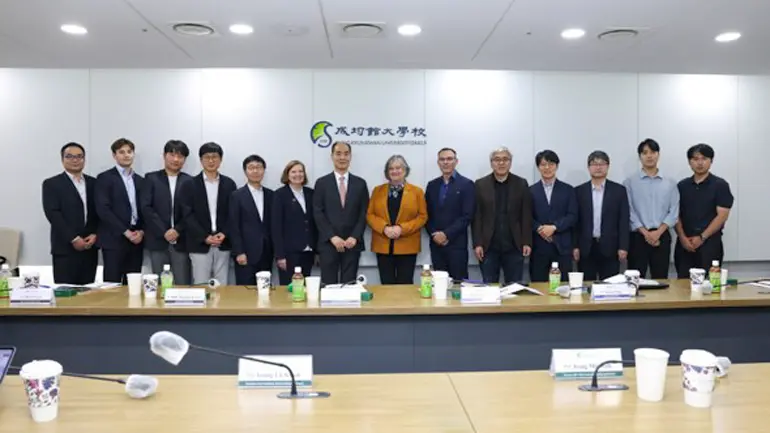
Researchers and institutional representatives from the University of South-Eastern Norway (USN) and Sungkyunkwan University (SKKU), together with the Research Council of Norway and the Royal Norwegian Embassy in Seoul, met in Seoul on 29 September to strengthen Norway-South Korea collaboration in green hydrogen research and related energy technologies.
Photoelectrochemical hydrogen production uses sunlight to split water and produce hydrogen. Although the approach has considerable potential, maintaining the performance of photoelectrodes over long periods remains a major challenge.
The Korea-Norway project studies chemical, photoelectrochemical and mechanical degradation during operation. The aim is to use this knowledge to improve protective layers, interfaces and bubble management, and ultimately develop more durable devices.
The project sets ambitious development targets: more than 14% solar-to-hydrogen efficiency using low-cost materials and more than 500 hours of stable full-cell operation. Achieving these targets requires a better understanding of how catalysts, protective layers and light-absorbing materials change during operation.
“An important part of the project is to move from the question of how high an efficiency we can achieve to how we can maintain that performance over time. For practical applications, stability is just as important as the initial efficiency” says Professor Kaiying Wang from the Department of Microsystems, USN.
He presented the South Korea-Norway joint research project South-Korea and Norway collaboration: Stable devices for photoelectrochemical hydrogen production. The project is jointly led by Professor Wooseok Yang at Sungkyunkwan University (SKKU) and Professor Kaiying Wang at USN.
The programme brought together university leaders and researchers from both countries. Among the Norwegian participants were Dr. Eva Falleth, Director for Sustainable Development at the Research Council of Norway, and Hilde Haaland-Kramer, Counsellor for Higher Education at the Royal Norwegian Embassy in Seoul. USN was represented by Head of Department Marius Stian Tannum, Professor Kaiying Wang and researcher Dr.Kang Du.
The hydrogen collaboration is led by Professor Kaiying Wang at USN and Professor Wooseok Yang at SKKU. The meeting provided an opportunity to review the ongoing bilateral project, discuss the next stages of the research and consider how the partnership can develop further.
USN combines microfabrication with operando analysis
USN's role combines micro- and nanofabrication at the Department of Microsystems and NorFab with materials characterization and electrochemical analysis. This makes it possible to connect how devices are fabricated with how they perform and degrade.
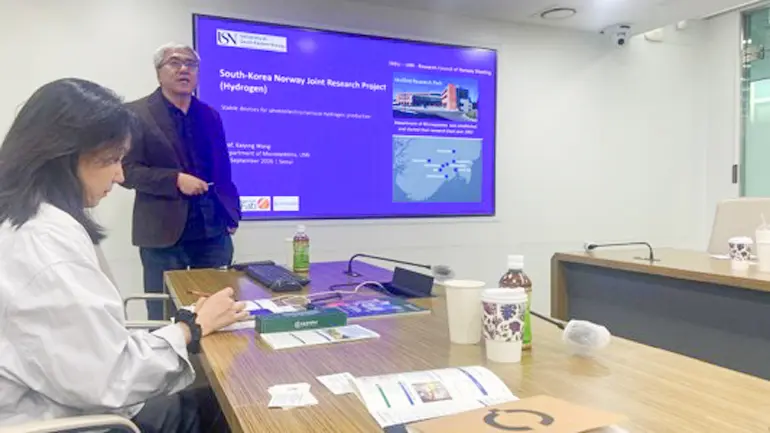
Facilities available to the project include wafer-level processing, dry and wet etching, PVD, electron microscopy, Raman spectroscopy and electrochemical analysis. Operando methods allow researchers to monitor changes in materials and interfaces while reactions are taking place.
A new in situ FTIR platform adds the ability to identify surface species and reaction intermediates under electrochemical conditions, providing deeper insight into activity, reaction pathways and degradation.
A partnership already delivering
The collaboration between USN and SKKU predates the current funded project and already includes reciprocal research visits, a six-month research stay by a South Korean student at USN, and joint papers and manuscripts.
The bilateral project provides a formal framework for combining complementary strengths. SKKU contributes world-class capability in high-efficiency photoelectrochemical device fabrication and interface engineering, while USN contributes advanced in-operando analysis, electrochemical diagnostics, NorFab infrastructure and silicon micro/nanofabrication. This complementarity is central to identifying degradation mechanisms and translating them into more durable device designs.
From the Seoul meeting to research discussions in Suwon
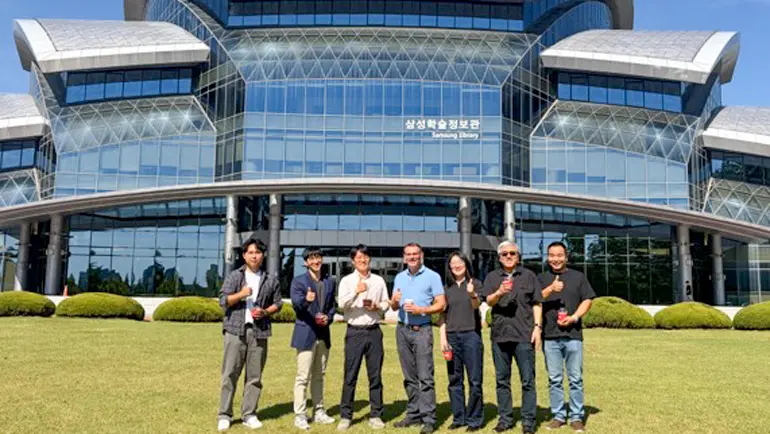
The Seoul meeting was followed by further scientific discussions at SKKU's Suwon campus. The visit provided an opportunity to review ongoing work, discuss the next stages of the hydrogen project and identify areas where the two research environments can work more closely together.
Building on the hydrogen collaboration
One possible longer-term direction discussed during the visit was protected black silicon. This links USN's expertise in silicon micro- and nanostructuring with the protection and durability research being developed in the hydrogen project, and could support future photoelectrochemical applications.
The partners also discussed possible follow-up links in microfabrication, MEMS, sensor technologies and semiconductor-related research. These are longer-term opportunities that could broaden the institutional relationship while building on the collaboration established through the current hydrogen project.
“We have complementary infrastructure and expertise. The current hydrogen project gives us a strong basis for developing more durable photoelectrochemical devices and for building a longer-term research collaboration between USN and SKKU”.
Professor Kaiying Wang, USN
Looking ahead, USN and SKKU aim to continue researcher exchange and develop new bilateral activities around durable photoelectrochemical devices, interface engineering, micro- and nanofabrication and operando analysis.
During the same visit to South Korea, Head of Department Marius Stian Tannum also visited Korea Maritime & Ocean University in Busan to explore opportunities for cooperation in maritime technology. Their hybrid propulsion lab with both AC and DC power distribution systems that also included batteries and hydrogen fuel cell technology was particularly interesting for future collaboration.