 10.00
-
15.00
10.00
-
15.00
 Drammen, Auditorium A5508, campus Drammen and Zoom

Shanti Gretta Pasanha is defending her thesis for the degree philosophiae doctor (PhD) at the University of South-Eastern Norway. 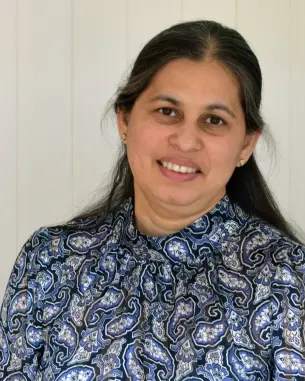
The doctoral work has been carried out at the Faculty of Humanities, Sports, and Educational Science, intstitute for mathematics and science.
Summary
This doctoral research advances understanding of the storylines, or grand narratives, that emerge in immigrants’ perspectives as they share their experiences of learning mathematics in a new language, Norwegian. Using interviews, participatory classroom observations, and a strengths-based teaching approach, the dissertation investigates how storylines about mathematics learning are constructed, negotiated, navigated, and potentially changed in multilingual mathematics classrooms.
Despite increased research attention to language diversity in mathematics education, immigrant students are viewed through a «deficit» lens that highlights what they lack, especially in language skills, rather than recognising the strengths they bring, including multilingual abilities, prior mathematical knowledge, and diverse life experiences. These assumptions and positionings can shape how students participate in class, how they see themselves as learners, and even their future educational pathways. Focusing on newcomers - students who have recently arrived in Norway - the study examines their perspectives on mathematics learning and how these conversations can either limit or expand students’ learning opportunities.
At the same time, teachers face complex pedagogical dilemmas as they attempt to balance the demands of the mathematics curriculum, monolingual norms, and inclusive practices that value students’ linguistic and cultural resources. These tensions are evident in introductory or «innføring» classes, where Norwegian is often the sole medium of instruction and where both students and teachers must negotiate competency goals with limited pedagogical guidance.
Across three connected studies, the research shows that deficit-based and strengths-based perspectives often coexist. Findings from Studies 1 and 2 examine storylines from a researcher’s and newcomers’ perspectives, respectively. While some classroom interactions reinforced limiting assumptions about immigrant students, others opened possibilities for seeing students as capable and resourceful mathematics learners. These insights informed Study 3, which highlighted the important role of the teacher-researcher in examining the challenges of shifting away from deficit thinking and toward approaches that build on students’ strengths.
All three studies underscored the importance of the researcher's positionality, which proved central, influencing data interpretation, classroom practice, and ethical decision-making.
Given the central role of mathematics as a school subject and the expectations for learning Norwegian in «innføring» classrooms, which influence students’ future educational and professional pathways, further research focusing on this group is warranted. Therefore, this doctoral study argues that it is important that educators recognise and build on the knowledge, languages, and experiences students already possess to create more equitable and supportive mathematics learning environments.