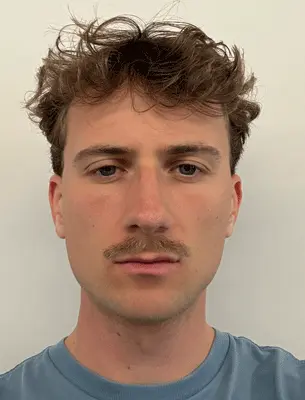
 Benoît Glauser is a third‑year PhD researcher in molecular and macromolecular chemistry at the University of Rennes, France.
His research sits at the intersection of chemistry, magnetism, and light–matter interactions.
- Industry relevance tags: Advanced materials, Molecular electronics, Data storage, Quantum technologies
- Core research problem: How magneto-chiral dichroism in chiral single-molecule magnets can be controlled and modulated, enabling new ways to manipulate light–matter interactions for molecular-scale data storage and advanced functional materials.
“Can individual molecules become the building blocks of future data storage technologies?”
Benoît Glauser, The Short Version
- LinkedIn: www.linkedin.com/in/benoît-glauser
- University: University of Rennes
- Location: Rennes, France
Benoît Glauser is a third‑year PhD researcher in chemistry at the University of Rennes, working on chiral molecules with magnetic properties.
His work explores magneto‑chiral dichroism and how this effect can be modulated using molecular switches, with long‑term relevance for molecular‑scale data storage.
He is interested in entrepreneurship, international research environments, and leadership development.
Outside the lab, he finds inspiration in nature and social interactions.
Chirality, Magnetism, and Molecular Switching
Benoît holds a master’s degree in chemistry with a major in organic chemistry and is currently completing a PhD in molecular and macromolecular chemistry. His research focuses on the synthesis of chiral molecules incorporating lanthanide ions, systems that display magnetic bistability and are promising candidates for data storage at the molecular scale.
The combination of chirality and magnetism gives rise to magneto‑chiral dichroism, a subtle cross‑effect between light and matter. Benoît’s work demonstrates that this effect can be actively modulated through the use of molecular switches, opening new perspectives on how molecular systems can be controlled and tuned.
From Industry to Fundamental Science
Pursuing a PhD was not originally part of Benoît’s career plan. After spending time in the workplace following his master’s degree, he realized that he wanted to deepen his understanding of fundamental science and develop stronger research skills.
“I was surprised by how much I enjoy research, and by how naturally the idea of staying in academia started to make sense.”
Along the way, the PhD experience taught him to take ownership of his work, find intrinsic motivation, and move forward without waiting for external validation.
Curiosity Beyond Chemistry
Outside his core research, Benoît has broad and exploratory interests, including climate science, sociology, and linguistics. These interests reflect a desire to situate scientific work within a wider societal and cultural context.
He is particularly curious about entrepreneurship after the PhD, especially in an international setting, and hopes to gain a clearer picture of how scientific expertise can translate into new ventures.
Looking Ahead
Through the TESE Days network, Benoît hopes to better understand what it means to develop an entrepreneurial mindset and which tools can support long‑term career development. Strengthening leadership, teamwork, and IT skills are key priorities as he prepares for the next phase of his professional journey.
“I want to explore how scientific research can evolve into something that creates value beyond the lab.”