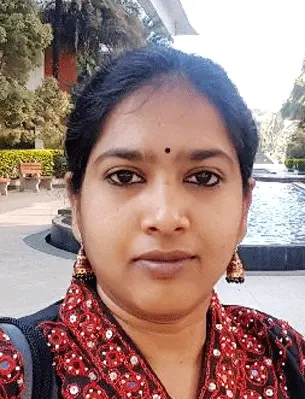
 Kranti Chalamalasetti is a fourth‑year PhD researcher based in Potsdam, working in the Computational Linguistics department at the intersection of artificial intelligence, language understanding, and human‑machine interaction.
Her research focuses on enabling AI systems to act as interactive agents that understand instructions, plan actions, and collaborate with humans in real‑world settings.
- Industry relevance tags: AI, Human–AI interaction, Automation, Intelligent systems
- Core research problem: How AI systems can become reliable interactive agents that understand instructions, collaborate with humans, and operate safely in real-world environments.
“I want AI systems that people can actually rely on; tools that work with humans in the real world.”
Kranti Chalamalasetti, The Short Version
- University: University of Potsdam
- Department: Computational Linguistics
- Location: Potsdam, Germany
- Email: kranti.chalamalasetti@uni-potsdam.de
Kranti Chalamalasetti is a fourth‑year PhD researcher in computational linguistics at the University of Potsdam, working on interactive AI systems that can understand language, plan actions, and collaborate with humans.
Her research explores dialogue games, task‑oriented dialogue systems, and collaborative building scenarios inspired by industrial assembly, with a strong focus on evaluation and reliability.
She is particularly motivated by bridging research and practice, and by learning how AI ideas move from prototypes into robust, usable tools.
Outside of research, reading, podcasts, conversations with people from different backgrounds, and spending time outdoors help her recharge and stay curious.
Building AI That Can Collaborate
Kranti’s doctoral work lies at the heart of a pressing question in AI research: how to design systems that can meaningfully collaborate with humans. She studies AI as an interactive agent, capable of understanding instructions, planning actions, and adapting through interaction.
She explores these challenges through interactive scenarios such as dialogue games, collaborative building tasks inspired by industrial assembly, and task‑oriented dialogue systems.
These settings allow her to test how AI systems behave when instructions are imperfect, and coordination matters.
From Performance to Reliability
A defining aspect of Kranti’s work is her focus on evaluation. Alongside building models, she develops evaluation frameworks that reveal where systems succeed and where they break down.
This perspective reflects a broader ambition: moving toward understanding reliability, failure modes, and practical usefulness. Her goal is to help AI systems earn trust in real‑world applications such as automation, human‑AI collaboration, and intelligent assistants.
“If we want AI in the real world, we need to understand not only when it works, but when and why it fails.”
Curiosity Beyond a Single Discipline
Outside her core research, Kranti has broad and exploratory interests. She is curious about how AI connects with the economy, industry, and real‑world systems, and how interdisciplinary perspectives can strengthen technical work.
This curiosity drives her to think beyond academic boundaries and consider how language technologies interact with organizational processes, products, and human workflows.
Looking for Industry and Interdisciplinary Bridges
Kranti is especially interested in collaborations that connect research with practice. She would benefit from working with industry partners in robotics, automation, and human‑AI interaction, where real‑world constraints expose gaps that academic settings often miss.
She is also keen to connect with entrepreneurs, product teams, and applied research labs to learn how research prototypes become robust, scalable tools.
For her, networking is not only about collaboration, but about understanding the full journey from idea to impact.
Inspired by Ideas and People
Outside of work, Kranti draws energy from exploring new ideas through reading, podcasts, and conversations with people from diverse backgrounds. These exchanges help her challenge assumptions and see her work from new perspectives.
Spending time outdoors plays an equally important role, helping her clear her mind, recharge, and maintain balance during an intense PhD journey.