 08.30
-
17.30
08.30
-
17.30
 Kongsberg, Becker Auditorium, Krona


Abstract
Effective Systems of Systems Engineering depends on the ability to align diverse stakeholders, disciplines, and organizations around a shared understanding of purpose, structure, and constraints. Industry faces persistent challenges related to large volumes of engineering information, envisions of a single source of truth, difficulties in communicating system intent to diverse stakeholders, and disconnects between informal collaboration and formal engineering processes.
KSEE 2026 examines how digital engineering practices, including MBSE, digital thread, systems architecting, and conceptual modelling can address these challenges when applied as enablers of everyday work rather than as isolated methods or tools. The focus is on ways of working that support shared understanding, alignment across disciplines, and continuous validation throughout the lifecycle. This year's event highlights how shared models and digital continuity help connect informal decision‑making with formal system artefacts, improve transparency, manage change, and ensure that intended system capabilities are effectively realized in operation.
Speakers
Keynote:
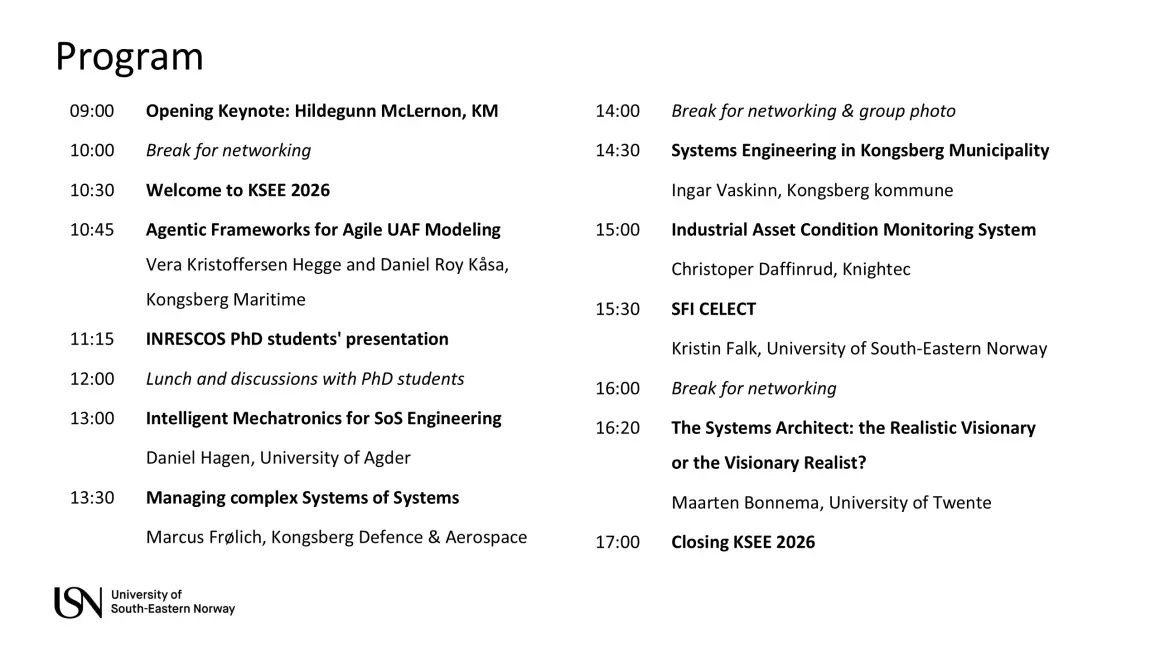
Hildegunn McLernon, Senior Vice President Technology Office, Kongsberg Maritime
Title: Vessel of the future – an integrated system of system approach
Abstract: The maritime industry is facing increasing system complexity driven by rapid technological development, growing requirements, limited standardization, and diverse operational demands across market segments. As vessels evolve into highly connected, software‑intensive systems, value creation increasingly depends on how effectively multiple products, platforms, and partners are integrated into coherent system‑of‑systems solutions. This presentation demonstrates how Kongsberg Maritime applies systems engineering to manage this complexity and enable reliable, safe, and sustainable vessel infrastructures of the future.
Speakers list:
Maarten Bonnema, University of Twente, the Netherlands
Title: The Systems Architect: the Realistic Visionary or the Visionary Realist?
Marcus Frølich, Kongsberg Defence & Aerospace
Title: Managing complex systems-of-systems
Daniel Roy Kåsa (Systems Architect) and Vera Kristoffersen Hegge (Senior Manager Enterprise Architecture), Kongsberg Maritime
Title: Accelerating the Architecture Gradient: Human-in-the-Loop Agentic Frameworks for Agile UAF Modeling
Abstract: Traditional Model-Based Systems Engineering (MBSE) often struggles with an inherent agility bottleneck: the time and effort required to build, maintain, and translate complex models frequently outpaces the rapid decision-making needs of project stakeholders. This challenges the systems architect’s ability to efficiently bridge the gap between high-level Conceptual Visions and highly formalized System Architectures.
This presentation introduces a novel method implemented at Kongsberg Maritime that utilizes LLM-driven Agentic frameworks to dramatically accelerate the knowledge management pipeline. By deploying semi-autonomous, interactive agents, we have automated the mundane tasks of capturing unstructured information (e.g., whiteboards, documents, and sketches) and normalizing it directly into a structured Unified Architecture Framework (UAF) core.
Crucially, this method maintains a strict human-in-the-loop paradigm. Systems Engineers retain full control, validating and refining the agents' structural interpretations while dedicating their time to high-value analysis rather than manual data entry. Furthermore, the framework operates bidirectionally, allowing agents to instantly generate tailored, unstructured views back out to address individual stakeholder concerns across the engineering gradient.
The application of this method has collapsed traditional analysis timelines from weeks to hours. This drastic reduction in lifecycle friction unlocks a critical "fail-fast" mentality, empowering Systems Engineers to manage and analyze highly complex systems-of-systems interactions that were previously cost- and time-prohibitive.
Daniel Hagen, University of Agder, Norway
Title: Intelligent Mechatronics for System of Systems Engineering
Abstract: A system of systems is only as capable as the machines inside it. Passive constituents push the burden of coordination onto integration; constituents intelligent enough to handle more themselves make the whole more tractable. Engineering such machines is itself starting to change. In software, AI already writes much of the code, and the engineer's effort shifts to deciding what to build; physical engineering is starting to follow. One reason it lags, the one this talk takes up, is that the knowledge is not in a form an AI can use: the models sit in tools made for people, and the reasoning behind them stays in the engineers' heads. The way forward is co-intelligence: with that knowledge made usable, the engineer becomes a systems thinker, framing the problem and judging the result while the AI does the detailed design. One such engineer can then span the disciplines a complex machine needs, where it once took a team. Mechatronics, where hardware and software meet, is where this is hardest and most valuable, and where the machines we build most shape what a system of systems can do.
Christopher Daffinrud, Knightec
Title: Behind the Dashboards: Asset Modelling, Contextualization and Stakeholder Alignment in an Industrial Asset Condition Monitoring System
Abstract: Industrial plants generate vast volumes of sensor data, yet it is rarely ready for the machine learning and AI organizations want to apply to it. Real-time, maintenance, and historic data often sit in siloed systems with inconsistent naming and little context. The layer that organizes and contextualizes this data is often missing. This layer is also what separates reactive maintenance from the condition-based and predictive approaches that industry is increasingly moving towards.
This presentation looks behind the dashboards of an Asset Condition Monitoring System (ACMS) for rotating equipment. The system was built on an industrial data platform during the Green Zinc Odda expansion at Boliden Odda, a Norwegian zinc plant, and covers roughly 250 machines and 800 sensors. The ACMS was the first system developed on this platform at Boliden. The platform itself is a first-of-its-kind combination of services and integrations, and the development of the ACMS played a central role in shaping the platform's design.
In the asset condition monitoring project, Knightec Group sat at the intersection of these efforts. In this presentation we discuss the engineering work users rarely see: modelling equipment, breaking the plant down into a standardized structure and naming scheme, and managing risks and dependencies across many connected systems. Much of it comes down to stakeholder alignment, and even small technical decisions require negotiation to reach a shared understanding.
Using the ACMS as a case, we ask where the real value lies: in the platform, or in the engineering and alignment that turn scattered data into a single source of truth that people, and eventually AI, can rely on?
Ingar Vaskinn, Kongsberg Kommune
Title: Systems Engineering, Kongsberg kommue
Ali Kaboli, PhD candidate INRESCOS, University of NTNU
Title: Advanced Informatics for Distributed Grid Balancing Through Flexibility Aggregation
Abstract: The main objective of this project is to develop, validate, and assess advanced operational tools designed to assist aggregators in integrating small and medium-sized distributed energy resources, particularly EWHs, into the balancing markets. This integration supports grid balancing and offers financial benefits to end users, enabling them to profit from flexibility extraction while contributing to the overall stability and sustainability of the Nordic power system.
Luciano Netto de Lima, PhD candidate INRESCOS, University of South-Eastern Norway
Title: Cooperative Autonomous Drones for Preparedness: Enabling Operational Applications from Research.
Abstract: This presentation introduces a PhD project within the INRESCOS research school focused on cooperative autonomous drone fleets for preparedness and critical operations. The work addresses the operational challenge of rapidly and efficiently covering large areas to improve detection probability while reducing response time and resource usage. These challenges are also relevant to search and rescue, surveillance, inspection, offshore incidents, environmental emergencies, and other large-area operations.
The research develops a coordination framework that enables multiple fixed-wing unmanned aerial vehicles (UAVs) to operate collaboratively with minimal human intervention. Using predictive decision-making and probability-based search maps, each drone continuously adapts its trajectory to focus effort where it is most valuable while avoiding redundant coverage. The approach aims to support scalable operations under realistic constraints such as limited communication, energy endurance, environmental uncertainty, and real-time decision requirements. The work currently focuses on high-fidelity simulation and system integration, with intellectual property under development.
Ramy Antar Ahmed Alham, PhD candidate INRESCOS, University of Agder
Title: Modelling and Control of Self-Hoisting Crane for Offshore Wind Turbine Maintenance.
Abstract: The number of offshore wind turbines (OWTs) has significantly been increased in recent years due to the global demand for clean energy. However, replacing major components in these turbines is challenging and often requires jack-up vessels and heavy-lift cranes, which are expensive and complex to operate. A self-hoisting crane (SHC) is a type of crane designed to lift itself up along wires towards the top of a wind turbine tower, without the need for external lifting equipment or auxiliary cranes. SHC offers a simpler and more cost-effective alternative, enabling efficient installation and maintenance. However, SHCs are currently limited to onshore wind turbines, as their operation relies on fixed structures to provide stable guide wires for climbing the turbine. Adapting SHCs to offshore wind turbines remains an unexplored area of research, with challenges posed by dynamic marine environments.
The main objective of this work is to model and control the dynamic behaviour of SHC system when operated with floating vessels for major repair tasks on both bottom-fixed and floating OWTs. Floating vessels with floating wind turbines introduce unique complexities, including motion induced by environmental forces such as wind, waves, and currents. These factors significantly affect guide wire tension and create load-handling challenges between the wind turbine with the SHC mounted on top and the vessel. This work will further focus on developing advanced control strategies, such as Active Heave Compensation (AHC) and Dynamic Positioning (DP), to ensure stable, efficient, and reliable operations under dynamic environmental conditions.
Sachin Banjade, PhD candidate INRESCOS, University of South-Eastern Norway
Title: Biomethanation for Biogas Upgrading and Industrial CO₂ Conversion. Experimental development of energy-efficient trickle-bed reactors and integrated Power-to-Gas concept.
Abstract: The reduction carbon dioxide (CO2) into methane (CH4) offers a two-fold solution: producing value added product while preventing release of CO2 into the atmosphere. Conventional methanation processes are energy-intensive and economically challenging. Bio-methanation technology, operated at milder conditions, offers a promising alternative process to reduce energy demand. This renewable pathway can reduce fossil fuel dependency and mitigate emissions, aligning global goals for energy storage, grid injection, and industrial decarbonization.
In this study, three 1.2 L lab scale trickle bed reactors (TBRs) packed with six alternating layers of LECA and plastic media were operated for 30 days. H₂ utilization rose from 16.83–18.99 mmol L⁻¹ d⁻¹ (days 1–10) to 25.53–27.55 mmol L⁻¹ d⁻¹ (days 11–30) with high H₂ conversion (96.3–97%), while CH₄ production reached 7.72–8.27 mmol L⁻¹ d⁻¹.
TBRs for biomethanation are currently at TRL level of 3-4 at laboratory scale and approaching TRL 6-7 level with further pilot scale demonstration. TBR shows promising aspects for future industrial solutions, including containment of toxic industrial flue gases such as H2S, CO and into value added products. Future work will focus on integration of TBR with other systems (electrochemical, anaerobic digestion), to further enhance methane yield.
Md Ali Akram, PhD candidate INRESCOS, University of NTNU
Title: Aluminium Post Consumer Scrap Sorting and Recycling to Develop a Circular Value Chain in the Automotive Supplier Industry.
Abstract: Aluminium recycling is a key requirement for reducing environmental impact and promoting sustainable manufacturing in the automotive industry. Traditionally, recycling of aluminium has been focused on producing cast alloys, which limits the potential for high-performance applications. However, the automotive sector requires wrought aluminium alloys (5XXX, 6XXX, and 7XXX series) for structural components due to their strength, corrosion resistance, and lightweight properties. Wrought aluminium manufacturing is reliant on primary aluminium due to strict alloy purity requirements, which is energy-intensive and contributes to global carbon emissions. With growing demand and the shift toward electric vehicles, the automotive industry faces challenges in sourcing high-quality wrought aluminium alloys from post-consumer scrap (PCS), due to strict alloy composition requirements.
This PhD research addresses these challenges by investigating Laser Induced Breakdown Spectroscopy (LIBS), as an advanced sorting technology capable of separating aluminium scrap into specific wrought alloy families based on their elemental composition. An industrial-scale LIBS machine at Metallco Fredrikstad is being evaluated for its ability to sort wrought aluminium alloys from PCS aluminium. In parallel, a Life Cycle Assessment (LCA) is conducted to compare existing open-loop recycling practices with the potential of closed-loop recycling using PCS aluminium. This analysis follows ISO standards to quantify environmental benefits, including reduced energy consumption and CO₂ emissions. This research also aims to develop a techno-economic and environmental assessment framework, integrating technical performance, cost modeling, and sustainability metrics. This framework will support decision-making for recyclers and manufacturers considering investment in advanced sorting technologies and circular production models.
Through experimental validation, environmental modeling, and academic dissemination the research will contribute to both scientific knowledge and industrial practice. Ultimately, it seeks to establish an adaptable model for circular aluminium use in the automotive sector by enhancing sustainability, resource efficiency, and innovation across the supply chain.
Project Partners: Benteler Automotive, Metallco Aluminium AS, Norsk Hydro
* Note: KSEE2026 will be held as a Special Session on Day 2 (30 June) of the 21st IEEE System of Systems Engineering (SoSE2026) Conference.