Find programmes Further education PhD programmes Why study at USN? How to apply Find study- and course plans USN Outbound Exchange Semester start Life as a student Housing and welfare Opportunities during your studies Special needs and student support Economy, management and politics Health and welfare Humanities Kindergarten, schools and higher education Natural Sciences Nature, health and environment Maritime enterprise Outdoor life, sports and physical education Technology Traditional arts and practical-aesthetic subjects Vision Science Commissioned research Democracy, social organisation and governance Energy, climate and the environment Health and welfare services of the future Upbringing, belonging and life skills Regional value creation Our PhD programmes PhD handbook PhD candidate pages Public Defences Doctoral graduation ceremony Industrial Research School in Complex Systems Stipendiary and Post-Doctoral Organization Science communication The Research Council of Norway EU-funded research and innovation projects Centres of Excellence Other projects Publishing USN Help Employees Collaborate with us Organizational chart Faculties Management Boards and committees Strategy and focus areas Work for us Bø Drammen Hønefoss Kongsberg Notodden Porsgrunn Rauland Vestfold Library Logo, design and graphic elements Management International Relations Key figures IT-services Ukraine Rules and regulations Student exchange to USN

My studies

  • Sorry, something went wrong here. We are currently experiencing issues with favourites.
no (Norwegian)

Public defence: Ecem Erman

Ecem Erman will defend her PhD degree in Technology. The thesis is about Carbon grown on porous aluminium allows the storage capacity and response speed of supercapacitors to be adjusted.


07 Dec

Practical information

  • Date: 7 December 2026
  • Time: 10.00 - 15.30
  • Location: Vestfold, A1-36 and Zoom
  • Download calendar file
  • Link to digital participation (Zoom) will come here

    Programme

    10.00-11.00: Trial lecture: Topic to be announced

    12.00-15.30: Public defence: Porous Aluminum Supported One-Dimensional Nanocarbons for Enhanced Capacitive Energy Storage

    Assessment committee

    • First opponent: Dr. Eng. in Material Science, Emile Haye, Innovative Coating Solutions S.A, Belgium
    • Second opponent: Research Scientist, Mihaela Kusko, National Institute for Research and Development in Microtechnologies (IMT Bucharest), Romania
    • Administrator: Researcher Eivind Bardalen, University of South-Eastern Norway

    Supervisors

    • Main supervisor: Associate Professor Pai Lu, University of South-Eastern Norway
    • Co-supervisor: Professor Kaiying Wang, University of South-Eastern Norway

    Chair of defence 

Any questions?

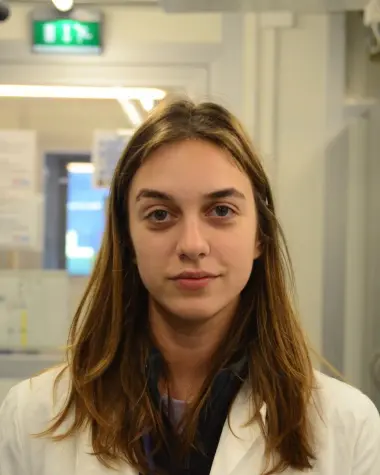
Portrett av en kvinne i hvit labfrakk innendørs, som ser på kameraet.

Ecem Erman is defending her thesis for the degree philosophiae doctor (PhD) at the University of South-Eastern Norway.

She has pursued the PhD program in Technology at the Faculty of Technology, Natural Sciences, and Maritime Sciences, Department of Microsystems.

You are invited to follow the trial lecture and the public defence.

  • Link to the thesis will come here

Abstract

Ecem Erman’s doctoral research shows how supercapacitors can be designed for faster power delivery or greater charge storage per unit area. She grew one-dimensional carbon nanomaterials on porous aluminium and adjusted their structure via tunning the processing conditions.

Supercapacitors store electrical energy and can supply short bursts of power. The aluminium in these electrodes acts as a support and an electrical conductor. Carbon grows on its surface and inside its pores. This forms the electrode without a separate step to mix carbon powder with a binder and coat it onto the metal substrate.

Across three studies, Erman developed electrodes for different operating needs. Open carbon structures enable an extremely fast charging/discharging rate relevant to smoothing voltage fluctuations in power supplies. More densely packed carbon increased charge storage per unit area. The carbon growth time also controlled the response speed within one same electrode design.

The findings provide a basis for selecting electrode processing conditions according to the intended use. Potential uses include power supplies and electronics that need short bursts of power. The next step is to test these electrodes in working circuits.