How can we treat wastewater more effectively and with lower energy consumption? That is the challenge for the major research project ESWAT (Energy-efficient and sustainable wastewater treatment), led by the University of South-Eastern Norway.
Michael Yitages Eshete is submitting his master's thesis in technology, process, energy and environmental engineering this summer.
His main project is to contribute to the research by investigating how a new type of reactor – called MABR (membrane aerated biofilm reactor) – can help achieve more efficient nitrogen removal.
Innovative technology
Collaborators on the thesis are Scan Water, Doscon and SINTEF, who are also part of the ESWAT project.
– My master’s thesis is about evaluating a sealed membrane-based biofilm reactor with air supply (MABR) for removing nitrogen from municipal wastewater. The study investigates energy-efficient and effective nitrogen removal under various operating conditions, explains Eshete.
He has designed two 30-litre membrane reactors for the tests.
The technology differs from traditional solutions by supplying oxygen directly to the biofilm through a membrane, without bubbles. This provides better control and higher efficiency in the treatment process.
See the full presentation of the master’s thesis here (PDF).
Great interest at conference in Trondheim
– Due to higher oxygenation efficiency, the technology can reduce energy consumption in treatment plants by 70–90 per cent compared with traditional biological treatment technologies, he says.
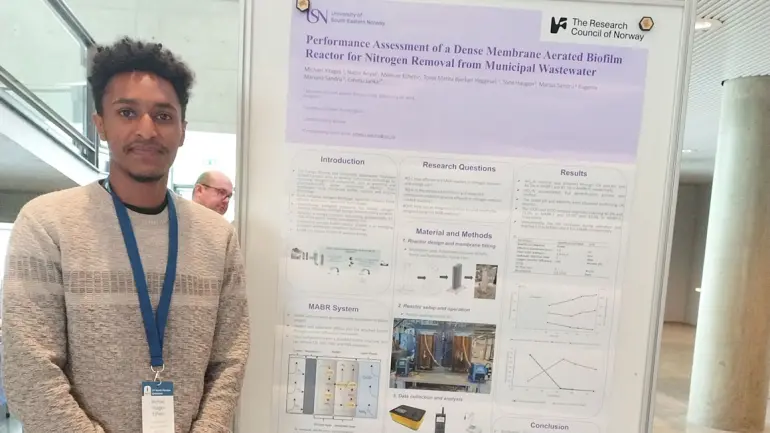
This week he presented results from the project at the Nordic Filtration conference in Trondheim, where both researchers and industry actors participated.
– The response to my poster presentation in Trondheim was very positive and motivating. Several participants showed great interest, asked relevant questions and gave constructive feedback, says Eshete.
Several of the participants also expressed interest in continued collaboration and development of new projects within membrane technology.
Continuing work at USN
For Eshete, working in the ESWAT project has been an important part of his studies at USN.
– The conference was an invaluable professional experience for me. I established contact with other researchers, exchanged ideas and received useful input for my master’s project, he says.
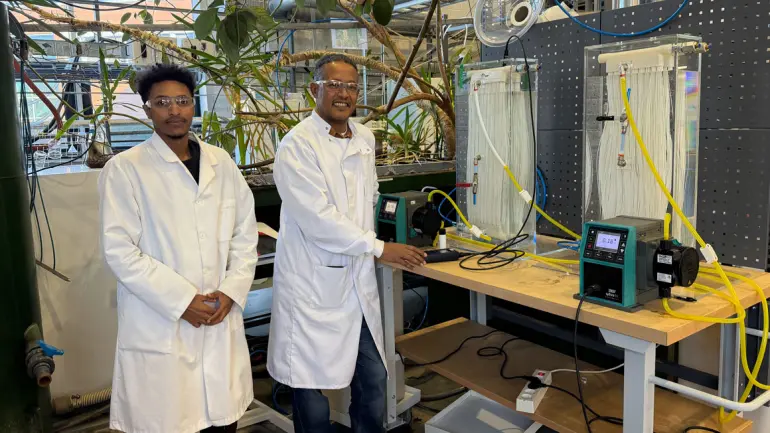
The water for the thesis was collected from Porsgrunn Municipality’s treatment plant and returned to the lab on campus Porsgrunn. He also took DNA samples for SINTEF, who will study the microbes in the reactor.
– Michael’s master’s thesis has made valuable contributions to the ESWAT project and to future research, says project leader Eshetu Janka Wakjera at USN.